
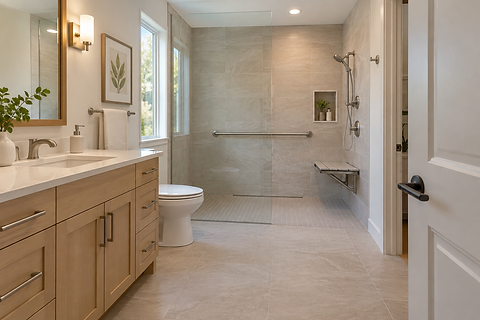
If you're thinking about making your bathroom safer, you probably have one question before any other: what will an accessible bathroom remodel cost? Is this a $1,000 fix or a $30,000 project?
It's a fair question. It's also one most contractors dodge until they've been in your home, which is frustrating when you're just trying to decide whether to take the next step.
So here is the honest answer. Accessible bathroom projects in Alachua and Marion counties, including homes in Gainesville, Alachua, Ocala and Tioga, generally land somewhere between a few hundred dollars for grab bars and $40,000 or more for a full remodel. Where yours falls depends on what the bathroom needs, and on what's under the floor and behind the walls.
Below, we'll walk through the four common levels of work (including walk-in shower, curbless shower and tub-to-shower conversion costs), what pushes the price up or down, and why a concrete slab matters in our area. If you're planning to age in place, this should help you decide what is realistic before anyone visits your home.
The Short Version
| Type of project | Typical range* | What it usually means | |---|---|---| | Grab-bar-only improvements | $300 – $1,500 | Properly anchored grab bars, sometimes a handheld shower and a raised seat | | Tub-to-shower conversion (low-threshold walk-in shower) | $6,000 – $12,000 | The tub comes out; a shower with a very low step goes in | | Curbless (zero-threshold) shower, also called a roll-in shower | $12,000 – $25,000 | No step at all; the floor flows into the shower | | Full accessible (handicap accessible) bathroom remodel | $25,000 – $40,000+ | New layout, wider door, new fixtures, finishes, and often plumbing and electrical changes |
*These are general planning ranges for our area, not quotes. Every home and scope is different, and we explain why below.
1. Grab Bar Installation and Small Safety Upgrades
Typical range: $300 – $1,500
This is the smallest step, and for some homeowners it's the right one.
The price depends less on the grab bar itself and more on how it's installed. A grab bar is only as strong as what it's attached to. Suction-cup bars and bars screwed into bare tile or drywall can pull out exactly when someone leans on them. That's the moment they matter most.
When we install a grab bar, it's anchored into the wall framing, or into solid blocking added behind the wall. That takes more time than a quick screw-in, and it's the reason a professional install costs more than a hardware-store bar.
Add-ons that often come along with this level:
- —A handheld shower head on a slide bar
- —A fold-down or fixed shower seat
- —Better lighting or a non-slip floor treatment
Is this enough? If you can still step over the tub wall safely and mainly want something solid to hold, it may be. If getting in and out of the tub is the real problem, grab bars alone won't solve it, and we'll tell you so.
2. Tub-to-Shower Conversion Cost (Low-Threshold Walk-In Shower)
Typical range: $6,000 – $12,000
This is the most common request we hear. If you're wondering what a tub-to-shower conversion or walk-in shower costs, this is the level most people mean. The tub comes out. A shower goes in with a low threshold, a small lip of an inch or two instead of a tall tub wall.
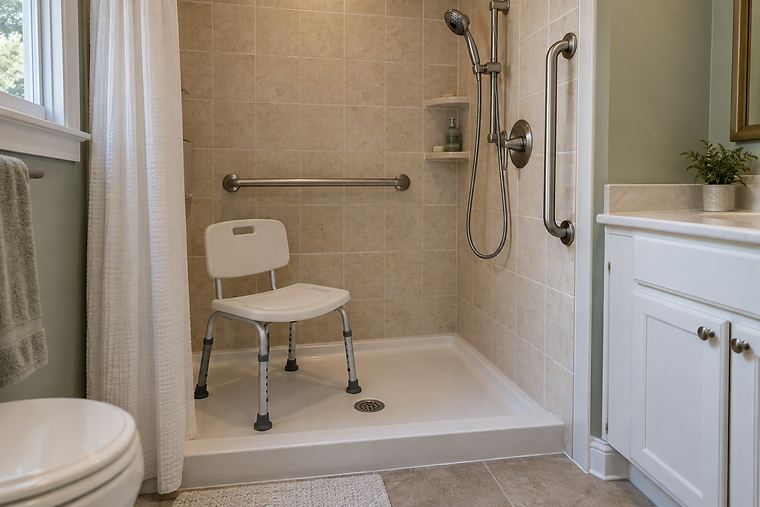 Illustrative bathroom concept; actual layouts and finishes vary.

It's a big improvement for safety and comfort, and it usually costs less than going fully curbless because the plumbing and floor structure can mostly stay where they are.
What drives the cost in this range:
- —Shower base or tiled pan. A prefabricated base is faster and less expensive. A custom tiled pan costs more but fits odd spaces better.
- —Wall surround. Solid panels cost less than tile; tile costs more in both materials and labor.
- —Glass. A curtain is the budget option. A frameless glass door can add $1,500 or more by itself.
- —Water damage found at demolition. Older tubs sometimes hide soft subfloor or rot, and we'd rather find it and fix it than cover it up.
3. Curbless Shower Cost (Zero-Threshold, Roll-In)
Typical range: $12,000 – $25,000
A zero-threshold shower has no step at all. The bathroom floor slopes gently into the shower, so a walker, a rolling shower chair, or a wheelchair can go straight in.
It's also the look most people picture when they say they want a bathroom that "doesn't look like a hospital." It looks like a modern spa bathroom. It just happens to be safe for the next 20 years.
It costs more because it's more construction work:
- —The shower floor has to sit lower than the rest of the bathroom, so the structure under it often has to be modified.
- —The drain usually moves, and the floor needs a carefully built slope and waterproofing so water stays where it belongs.
- —Waterproofing has to be done correctly. A curbless shower has no curb to forgive a mistake.
This is one of those jobs where the difference between a good installation and a rushed one shows up two years later as a leak. That is why we handle permits and inspections for this work according to the project scope and local requirements.
4. Full Accessible Bathroom Remodel Cost (Handicap Accessible and ADA-Style Layouts)
Typical range: $25,000 – $40,000+
Sometimes the shower isn't the only problem. The doorway is too narrow for a walker. The toilet is too low or too tucked into a corner. The vanity blocks the way. Turning around takes three tries.
A full accessible remodel can address all of that at once:
- —A wider doorway, often 36 inches or more
- —A reworked layout with real room to turn and transfer
- —A comfort-height toilet with proper clearances
- —A vanity you can use seated or standing
- —A curbless shower with a built-in seat and properly anchored grab bars
- —Slip-resistant flooring throughout
- —Better lighting and outlets placed where you can actually reach them
This is the range where the project becomes a true remodel instead of a repair, and where the final price can vary the most from home to home.
A note on "ADA": the Americans with Disabilities Act sets standards for public and commercial buildings, not for private homes. Many homeowners still use ADA-style dimensions, such as a roughly 60-inch turning space, as a helpful guide when planning a wheelchair accessible bathroom. We can build to those dimensions where your space allows, and we'll tell you honestly where it doesn't.
What Moves the Price Up or Down
These are the line items that explain most of the difference between a lower-cost accessible bathroom and a higher-cost one.
Plumbing Relocation
Moving a drain, toilet, or shower valve costs far more than leaving it where it is. If we can keep your plumbing in its current spot, the project stays smaller. If the best layout for safety means moving it, we'll show you the tradeoff so you can decide.
Electrical Work
Older bathrooms often don't meet current electrical code. GFCI protection, proper lighting, a ventilation fan that actually vents, and outlets placed within reach may all be part of the job. Some of this is required, not optional.
Permits and Inspections
We obtain required permits and arrange applicable inspections based on the project scope and local requirements. Permit fees are a modest part of the total, but they matter for a bigger reason: when an inspection applies, someone other than the contractor has checked the work. That protects you when you sell the home, file an insurance claim, or need a repair down the road.
If a contractor offers to "skip the permit" to save you money, that's a conversation worth ending.
Tile, Glass, Seating and Fixture Allowances
Your finishes are the biggest variable you control. In a written proposal, these show up as allowances: a set budget for items you'll choose, like tile, shower glass, a bench or fold-down seat, a vanity, faucets and a toilet.
A few examples of how the choices swing the total:
- —Tile: Large-format porcelain generally costs less to install than small mosaic tile with lots of grout lines, which also means less grout to keep clean. Whichever size you choose, shower-floor tile should be selected for appropriate slip resistance and drainage.
- —Glass: Curtain, framed door, or frameless glass, each step up costs more.
- —Seating: A fold-down seat is simpler; a built-in tiled bench is more work but feels like part of the room.
- —Fixtures: Basic comfort-height fixtures and premium designer ones can differ by thousands.
We'll never push you toward the expensive end. Our job is to show you the options and what each one does to the number.
Why Slab Construction Can Affect Cost in Gainesville, Alachua and Ocala
Most homes in Gainesville, Alachua, and much of Marion County are built on a concrete slab instead of over a crawlspace. That matters more than most people expect.
With a crawlspace or raised floor, plumbing is reachable from below, and lowering a shower floor is relatively straightforward. With a slab, the plumbing is embedded in the concrete.
That means:
- —Moving a drain or toilet may require cutting into the slab, trenching, running new pipe, and patching the concrete.
- —Creating a curbless shower may mean recessing the shower area into the slab or building up the rest of the floor.
- —The work is more labor-intensive and takes longer.
This doesn't mean a slab home can't have a beautiful accessible bathroom. It can. It just means that two bathrooms that look identical on the surface can price differently, depending on what's underneath.
Frequently Asked Questions About Accessible Bathroom Costs
How much does an accessible bathroom remodel cost in North Central Florida?
General planning ranges run from about $300 for grab-bar-only improvements to $25,000 – $40,000 or more for a full accessible bathroom remodel. A tub-to-shower conversion typically falls around $6,000 – $12,000, and a curbless shower around $12,000 – $25,000. These are planning figures, not quotes. Your home, your scope and what's behind the walls set the real number.
How much does a walk-in or curbless shower cost?
A walk-in shower with a low threshold, usually a tub-to-shower conversion, generally runs $6,000 – $12,000. A fully curbless (zero-threshold) shower generally runs $12,000 – $25,000, because the floor structure, drain and waterproofing take more work. We break the numbers down further in our curbless shower cost guide.
Is a tub-to-shower conversion cheaper than a curbless shower?
Usually, yes. A low-threshold conversion can often keep the existing plumbing and floor structure in place. A curbless shower typically needs the shower floor lowered or the surrounding floor built up, which adds labor and cost. If you use a walker, shower chair or wheelchair, the curbless option may be worth the difference, and we'll talk through that with you.
Does a home bathroom have to meet ADA standards?
No. The ADA applies to public and commercial spaces, not private homes. Many homeowners still use ADA-style measurements as a planning guide for a handicap accessible bathroom, and we're glad to design around them where your space allows.
Why does a concrete slab change the cost?
In a slab home, plumbing is embedded in the concrete. Moving a drain or toilet, or recessing a shower floor, can mean cutting into the slab, running new pipe and patching it. That is more labor than the same job over a crawlspace, so two similar-looking bathrooms can price differently.
Do accessible bathroom remodels need permits?
Not every project does, and it depends on the scope of the work. We obtain required permits and arrange applicable inspections based on the project scope and local requirements. Permit fees are a modest part of the total, and where an inspection applies, it means someone other than the contractor has checked the work.
Every Home and Every Scope Is Different
We want to be straightforward about this: no blog post can give you your price. The ranges above are a starting point to help you think about what's realistic. They are not a quote, an estimate, or a promise.
Your price depends on your home's age, its construction, what we find behind the walls, the layout you need, the finishes you choose, and current material and labor costs. That's why we don't give a number over the phone, and why we'd be skeptical of anyone who does.
What we can promise is how we'll work with you:
- —A written, itemized proposal, so you can see what each part of the project costs
- —No pressure. An assessment is a conversation, not a pitch
- —Permits and inspections handled based on the project scope and local requirements
- —An honest answer if another solution, or another provider, would serve you better
Ready to Know Your Real Number?
Schedule a Home Assessment for a project-specific written proposal.
We'll visit your home, listen to what's hard right now, evaluate the existing bathroom and discuss potential concealed conditions, and give you a clear, itemized proposal. No surprises, no pressure.
Call 352-756-3038 or email info@prcnow.com to schedule.
PRCnow, Independent Living Begins at Home. Accessibility • Remodeling • Outdoor Living.
Serving Alachua and Marion Counties · 12501 NW US Hwy 441, Alachua, FL 32615
Price ranges in this article are general planning figures for North Central Florida and are not quotes. Actual costs vary with your home, scope, materials and market conditions.